Showing posts with label Oregon. Show all posts

Wednesday, November 11, 2009

Which Stemware Should I Use For My Pinot Noir?

For many of you, especially my wine geek pals, this going to be laughing-out-loud basic, but I was reminded today that there are a lot of people who don't know how much the proper size and shape of stemware are critical to the enjoyment of pinot noir and all wines. Since this is a blog about Oregon wine and especially pinot noir, I'm going to address that issue.

Georg Riedel (REE-dle) of Riedel Glas Austria was the man who, along with support from wine critic Robert Parker and the recently deceased Robert Mondavi, popularized stemware designed specifically for each type of wine. Previous to his efforts that started in the mid-'80s, stems came in essentially three shapes - red wine (larger), white wine (smaller) and Champagne. The Champagne glasses were those little flat things that dissipated the bubbles and are rumored to have been modeled after Marie Antoinette's breasts, but I digress.

Georg designed stems for Bordeaux (cabernet), Burgundy (pinot noir), riesling, sangiovese, syrah and a host of others. He's even designed a stem specifically for Oregon pinot noir (as opposed to Burgundy or California pinot noir) that's very pretty and some people swear by it. Riedel's stemware is excellent, but they're expensive ($20-25 each for the machine-made stems and up to $90 for the handblown models) and they're really easy to break.

I used to buy Spiegelau stems because they were much more reasonable, but that company has been bought by Riedel and the quality has slipped a bit while the price has crept up. About a year ago I discovered the stems from Schott Zwiesel. They're made with lead-free crystal and, with an addition of titanium, they're much more difficult to break. I haven't broken one in a year and believe me, that's some sort of record. They're not UNbreakable, but they will stand quite a bit more abuse than Riedels. Just remember that the easiest way to break a glass (other than dropping it or smashing it on the kitchen faucet) is to twist the stem off while drying it by hand. The Schotts aren't immune to that, which is why I use the dishwasher, but if you live where the water is hard they're gonna spot, so just be careful.
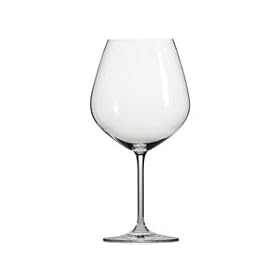

This is the shape you need for pinot noir. Notice the shape of the bowl. It's much more rounded than what you might expect and it's much larger, too. They hold almost 25 ounces, so you can get almost a whole bottle in one which, of course, you don't want to do. Just pour 4-6 ounces in the bottom and give yourself room to swirl and sniff.

You're probably thinking I'm out of my mind; that it doesn't really make any difference. Well, I'll tell you, I've performed an experiment many times with people who thought I was nuts and it's worked every single time. Pour some pinot noir into a smaller glass - your grandmother's crystal will work fine, as will any small wine glass or even a jelly jar - and some into a glass like the one above. Smell both. You won't believe the difference, and it even carries over into the flavors.

Put your old stems in the next garage sale and get some of these. They're available from Amazon, and they're a bargain at $12 each.

Sunday, November 1, 2009

So You Think You Hate Lamb?

I confess, I've never "gotten" why some people claim they don't like lamb. "It's 'gamey'", people say. "I've always heard it's strong and smelly," say others. Well, it's not and I have, once again, Tracey to act as my witness.

Having subjected her to roasted brussels sprouts and having her ask for them again, I figured it was time to force her to choke down some lamb. I had a small piece of a butterflied leg, so I treated it like a thick steak as I usually do, but indoors rather than on the grill, which would have been better. Alas, she managed to leave her grill behind in Reno when she moved, so the grill wasn't an option.


I seasoned it with salt and pepper and a bit of garlic, seared it in a cast-iron skillet and finished it in a 375 degree oven, removing it at 125 degrees. It was about 140 by the time the carryover cooking stopped, which was a bit more done than I'd like, but it was still tasty.  Here it is with Mom's green beans simmered forever in onions, garlic, tomatoes and oregano and some orzo "alfredo" - orzo with a sauce of butter, garlic and parmesan cheese. The picture isn't the best because the light was a bit off, but it was a yummy dish. And Tracey went back for seconds. I'm two for two with new foods!

Wine match: Lamb goes with almost any red wine and I'm often moved to choose a syrah or something from the rhone. This I matched with a 2008 single-vineyard pinot noir from the Willamette Valley that I can't name. It's not that I don't know, it's that I promised I wouldn't make public reference to it.

I had stopped by the winery for a bottle of the 2007 from the same vineyard and, despite the fact that they were in the middle of bottling their 2008s, they obliged me. It wasn't until after I'd gotten home that I realized they'd given me a just-bottled 2008 and, after telling them, they just asked me to keep quiet about it because it won't be released until next spring.

So, I won't tell you the wine, but I WILL tell you that it's up to the same standard shared by every 2008 Oregon pinot noir I've tasted from barrel and bottle. The aromatics are incredible and this, being from the Dundee Hills, was all red fruit - strawberries, raspberries, cherries and a little pomegranate with a bit of dustiness thrown in for good measure. It was perhaps a little overpowered by the tomatoes in the beans, but with the lamb it was perfect.

I'll do a more in-depth review of 2008 pinots later, but this one's worth saving up for when it's released, just like all of its cousins are.

Saturday, October 31, 2009

Another Step-by-Step: Chicken Cacciatore "Modernized"

I love chicken. I love vegetables. I love them together, but I never loved chicken cacciatore. For that matter, I never loved coq au vin, either. Why? The disgusting, rubbery mess that chicken skin turns into when you braise the pieces in liquid. Further, though I like white meat chicken, boneless-skinless breasts (which are one solution) are often like eating cotton. What to do?

I was vexed and set out some time ago to solve this problem.  Surprisingly, it wasn't all that difficult and it makes for a nice presentation to boot. I just had to think outside the envelope a little and get away from the "traditional" recipes you can find all over the Interwebs.

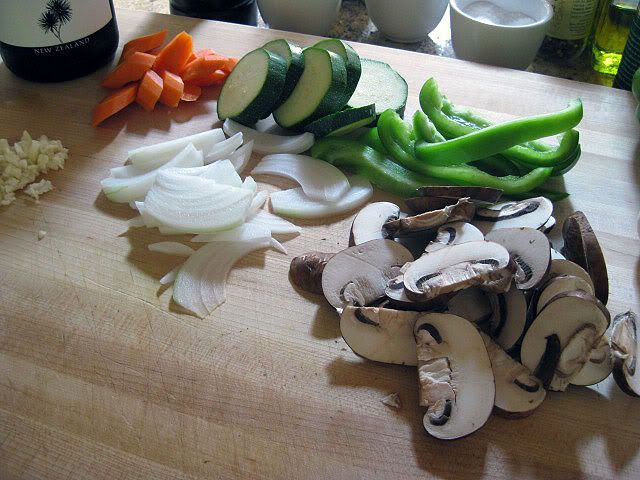
First, I borrowed some techniques from other dishes, the first being the ratatouille I posted about a while ago. Here's a shot of the vegetables all prepped and yes, that's a carrot you see. It adds a nice, earthy component to the dish. Bear in mind that  what you see is for one serving, so don't fret that there don't appear to be many vegetables.

Once you have your vegetables prepped, the first step to get the chicken started. Choose nicely-sized bone-in, skin-on breast haves and season them with salt and pepper. Heat some olive oil over medium heat in an oven-proof skillet until shimmering, and brown the breasts skin side down until nicely colored. Turn them skin side up and put the skillet in the oven at 375 degrees until they're cooked through -  about 25-30 minutes.

The second step is exactly like the ratatouille, and that's to separately lightly brown the zucchini, mushrooms and carrot and set them aside, then sweat the onions and peppers until soft and then stir in the garlic and allow it to become aromatic. If you don't like zucchini you can substitute (or add) yellow summer squash, and you can leave out the carrots, but the mushrooms have to stay or it's not "hunter's style". Add some diced canned tomatoes (about half a 14.5-ounce can for this one serving), return the other vegetables to the pan and cover. Simmer over low heat about 15 minutes. If you like, you can add a little white wine before adding the tomatoes and boil off the alcohol, but this isn't necessary.

In the meantime, bring a large pot of water to a boil and salt it liberally. It should almost taste like sea water. Cook a pasta shape of your choice (I like thin spaghetti or angel hair, but penne rigate or ziti would work) until done al dente, or "to the tooth". With all the other things in this dish, about 2 ounces per serving should be about right - half what you'd normally consider a serving of pasta. A note on pasta: I'm a huge fan of Barilla pasta. It's inexpensive and almost impossible to overcook. I used to like DiCecco, but I've graduated to Barilla. Also, this dish is not the place for fresh pasta, which would be overpowered by the strong flavors.

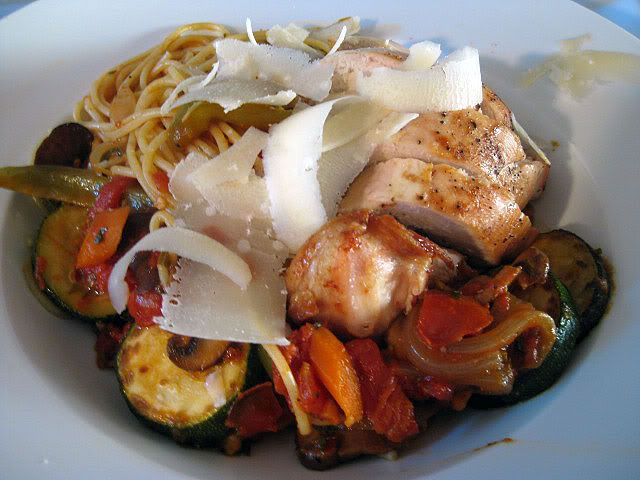
When the chicken is done, remove it from the oven and allow to cool just a bit so you can handle it, and carefully remove the meat from the bones.  Cut the breast into fat diagonal slices and serve it over the vegetables, which you've tossed with the cooked pasta. Shave some parmigiano reggiano over the top and you'll have something that looks like this.

Wine match: As with any dish with tomatoes, you want something relatively high in acid. It's easy to pick something from Italy, but this is a blog dedicated to food and wine of the Northwest, so try a barbera from Oregon or Washington. Mystic Wines in Salem makes an excellent one, and there are several I've seen but haven't tried from the Columbia Gorge. Lower-alcohol zinfandel would be good, too, but they're harder to find these days. And, in the summer, the Shy Chenin syrah rose would be just the ticket.

Buon appetito!

Thursday, October 29, 2009

It's Almost Dungeness Crab Season - Want The Perfect Wine?


Dungeness season starts on December 1 here in Oregon, so we're not that far off and you'll want the perfect wine for the first crabs of the year. Well . . . here it is, peeps.  Shy Chenin chenin blanc.  It's from my friends Chenin and Sean Carlton who also have Basket Case Wine, the off-dry Stumbling Block Wine and the huge, complex Reversal syrah from southern Oregon.  There's another Shy Chenin wine and it's a really good syrah rose that's best in warm weather but there's no reason you can't light a fire, crank up the heat or just get hot and bothered with your honey and have some over the winter.


I told the story about re-connecting with Chenin way back in my post about Pacific City, and it's a good one, so I encourage you to check the archives and read it. Just rest assured that Chenin, who was named after the chenin blanc vines her parents planted in Temecula in 1968 while her mom was pregnant with her, is anything but shy in real life, and neither is Sean. After all, how shy can they be when the motto for their Basket Case line is "Wine For The Crazy In All Of Us"?  How shy can either of them be when the educational page of their website - where you can find a long and detailed treatise on trichlorianisole (TCA), the compound that causes "cork taint" or a smell of musty cardboard in your wine - is entitled "Screw U"? But, as usual, I digress.


Find yourself some of this wine. It's aromatic, floral and crisp - just the perfect thing for Dungeness crab, hot or cold. They sell it mostly at their tasting room and at farmers' markets around Portland, but it's available in some retail outlets and they have out-of-state distribution, too. Ask around or, if all else fails, drop me a note and I'll get ahold of Chenin and find out where you can get some.  


And while we're on the subject of Dungeness crab, here are some tips I've picked up during my time here in the northwest.  One is, if at all possible, buy it live - or better yet catch it yourself.  While there's generally good turnover in crab you buy cooked, you don't really know how long ago it was cooked before being delivered to your retailer, who can only tell you when it came into the store.  The other advantage of buying them live is that your fishmonger should be willing to take the backs off them (killing them instantly) and clean them for you.  That way you can steam them without the body meat (the sweetest part) getting tainted by the innards.  


Another is not to use those hinged cracker thingies to crack the shells. All you end up with most of the time is pulverized shell in your crab. Get yourself a cheap dinner fork from Goodwill or a restaurant supply store and stick a tine into the little seam where the shell is soft on the legs and claws. Then sort of zip the fork along the leg longitudinally to create an opening. Now you can just open the shell the way you'd open a book and the meat will come right out. The body requires you to pick the cartilage out with your fingers anyway, so roll up your sleeves and go to it.


Lastly, try something kinda different to dip the crab in. Steep a crushed clove of garlic in some melted butter for about half an hour, then stir in a little bit of Sambal Oelek, available at Asian groceries and most regular supermarkets that have branched out beyond Wonder Bread and Velveeta "cheese".  Huy Fong is the brand I'm accustomed to seeing, but I'm sure there's more than one. It's a red chile paste, so be careful when you add it unless you like your food spicy, bearing in mind that too much spice will overpower the delicate crab.  


One more tip: If the crabs don't weigh at least a pound and a half (2 pounds is better) don't buy them.  The meat-to-shell ratio isn't very good.  


So there you have it.  I can't wait for crab season now that I've written this.  

A Screaming Deal On Oregon Pinot Noir & Pinot Gris

Made by our friends Linda and Art Lindsay at Stone Wolf in McMinnville, the two Rascal wines are true rarities. They're under $10 ($6.99 in some places) and they're varietally correct; a combination that almost never exists, especially with pinot noir. Typically, pinot noir this inexpensive reflects the grape only in that it's red and liquid, commonly because it has another wine - usually something cheap - blended into it. In California that can be as much as 25% of the finished wine but only 10% in Oregon, and that contributes to the difficulty in finding drinkable Oregon pinot noir in this price range.

It's possible there's something besides pinot noir in the Rascal, but given its flavor profile and knowing Linda and her passion, I seriously doubt it. This guy looks like pinot noir, smells like pinot noir and tastes like pinot noir. Ditto on the pinot gris which, though it has a little residual sugar in it, drinks fat and dry. You can't do better for the price and, in some instances, you won't do better for twice or three times the price.

If you see some, buy a couple of bottles. You won't be sorry.